Table of contents9 sections
- Introduction
- 1. KSeF will also cover the smallest business owners
- 2. From 2027, KSeF-related penalties will start to apply
- 3. The KSeF number will also matter in payments
- 4. The end of further exceptions and transitional periods
- 5. KSeF will continue to be developed
- What does KSeF 2027 mean for a business owner?
- Summary
- Sources
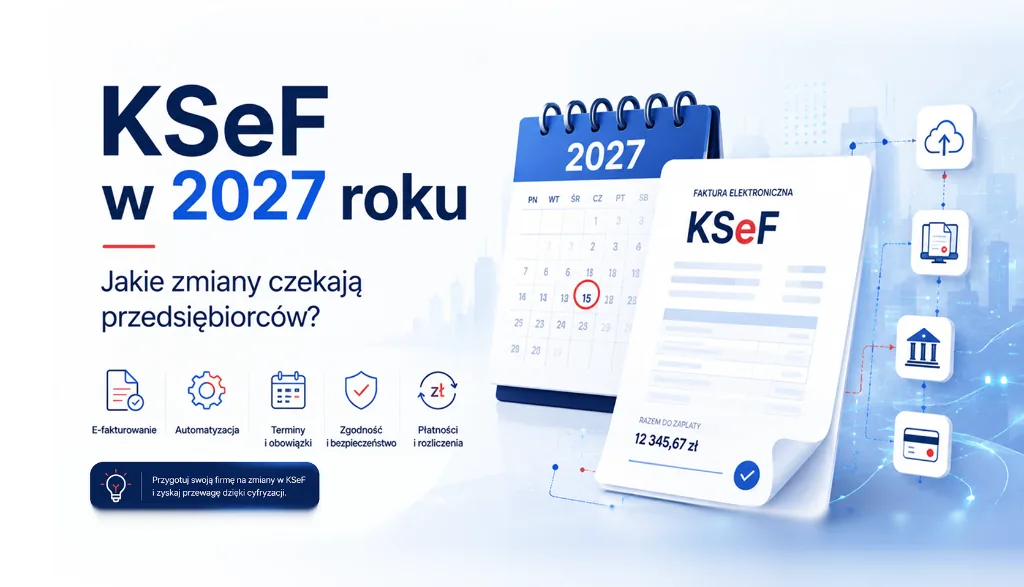
The National e-Invoicing System has been mandatory in stages since 2026, but 1 January 2027 will be another important date for business owners. That is when some of the transitional periods end and the smallest taxpayers become subject to the obligation.
The Ministry of Finance’s official website describes 1 January 2027 as the moment from which KSeF will cover all taxpayers subject to the e-invoicing obligation.
Below we present the most important changes as of 7 August 2026.
1. KSeF will also cover the smallest business owners
If monthly gross sales do not exceed 10,000 PLN, a business owner can use the transitional period for issuing invoices until the end of 2026. But from 1 January 2027 this exemption is due to cease to apply.
This means that even the smallest companies will be covered by the rules on mandatory invoice issuing in KSeF.
It is worth remembering that the obligation to receive invoices through KSeF was introduced earlier. So 2027 will mainly be the moment that closes the system on the issuing side as well, for the smallest entities.
3. The KSeF number will also matter in payments
One of the most important changes from 1 January 2027 will be a stronger link between an invoice issued in KSeF and the subsequent payment.
In certain cases, when making a transfer for a structured invoice, it will be necessary to give the KSeF number of that invoice. If a payment covers several documents, a collective identifier generated in KSeF can be used. The change will also apply to some payments made under the split payment mechanism.
In practice this means that KSeF stops being solely a system for issuing invoices.
The whole process will matter more and more:
- invoice → bookkeeping → payment → settlement
Companies should therefore review not only their invoicing software, but also how they make transfers, their accounting automations and their banking integrations.
4. The end of further exceptions and transitional periods
From 1 January 2027, cash registers lose their invoicing function. This means that receipts with a NIP of up to 450 PLN will no longer be simplified invoices, and every B2B sale will require a structured e-invoice issued directly in the National e-Invoicing System (KSeF).
5. KSeF will continue to be developed
Launching the system does not mean the end of its development. The Ministry of Finance is running consultations on further KSeF features and improvements.
One of the directions under analysis is the ability to pass on additional business events related to a specific invoice, and better synchronisation of information between KSeF and business owners’ systems.
It can be assumed that in the coming months KSeF will gradually evolve from a system used mainly for exchanging invoices into a more extensive element of the digital flow of financial documents.
What does KSeF 2027 mean for a business owner?
The biggest change is not limited to the way an invoice is issued.
An invoice appears in the system, then goes to accounting, and is linked to the payment, the bank account and the later settlement.
That is why, before the end of 2026, it is worth checking:
- whether the system you use is properly integrated with KSeF
- who in the organisation has the relevant permissions
- how emergency situations and offline mode are handled
- whether the payment process will handle KSeF numbers correctly
- how authentication of external systems works
- whether the staff responsible for invoices, payments and accounting know the new procedures
- whether data flows automatically between the invoicing system, the bank and accounting
Summary
1 January 2027 will not be the start of KSeF, but the moment when many transitional arrangements end.
The obligation will also cover the smallest business owners, penalties for incorrect use of the system will start to apply, and the KSeF number will begin to be used in payment processes too.
KSeF itself will continue to be developed. That is why 2026 is worth using for more than the technical connection of your invoicing software to KSeF.
It is a good moment to put in order the company’s whole financial flow: from issuing an invoice, through receiving and booking it, to payment and cash flow analysis.
A well-implemented KSeF can be not only another administrative obligation, but also an impulse to automate the company’s financial processes.
Sources
- Ministry of Finance — National e-Invoicing System (ksef.podatki.gov.pl): timetable, rules of operation, regulations and announcements concerning the system
- Ministry of Finance — KSeF implementation stages: deadlines for mandatory KSeF and transitional periods
- Ministry of Finance — KSeF number and collective identifier: using the KSeF number when making payments
- Ministry of Finance — KSeF certificates: rules on authentication and the use of KSeF certificates
- Ministry of Finance — consultations on KSeF 2.0 changes: planned development of the system, tokens and additional business events
- KSeF.pl — materials and studies on the implementation and practical operation of KSeF
- Poradnik Przedsiębiorcy — Changes in KSeF: a study of the changes planned in the system and their consequences for business owners
Information as of: 7 August 2026.
KSeF is still being developed, so some of the solutions planned for 2027 may change. Before taking implementation decisions, check the current announcements of the Ministry of Finance.