Table of contents10 sections
- Introduction
- What exactly is a liquidity gap?
- Liquidity gap versus profit. Why can a profitable company have no money?
- How does a liquidity gap arise?
- Payment gridlock deepens the problem
- How to recognise a gap before it becomes a problem?
- What to do if a liquidity gap already exists?
- How does Administy support liquidity gap management?
- The most important rule: manage liquidity forward
- Sources and literature
A company can have growing sales, signed contracts and a positive financial result, and still, at some point, lack the funds for salaries, taxes, subcontractors or other current payables.
This is one of the most dangerous paradoxes of running a business: profit does not automatically mean money in the bank account.
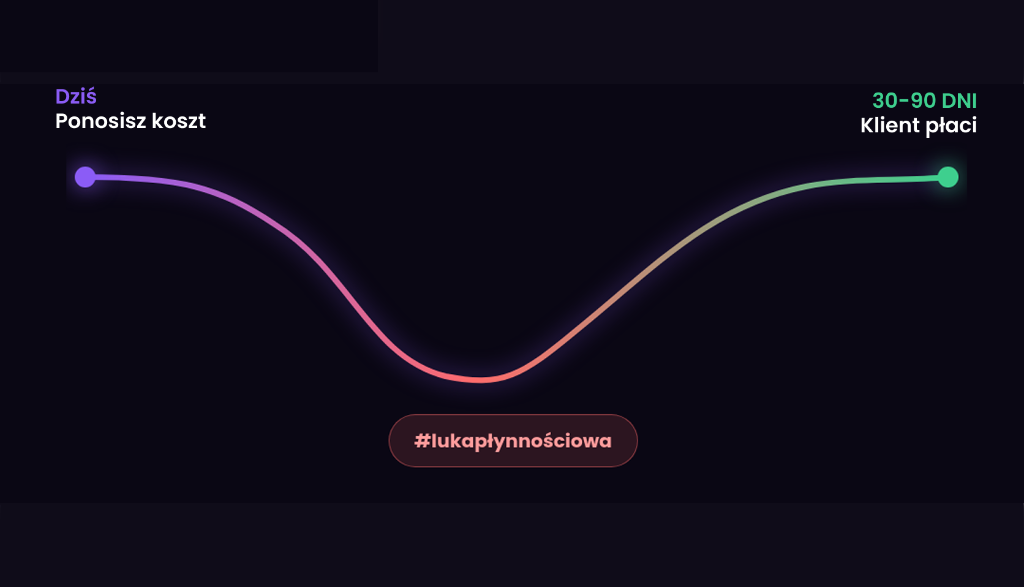
The problem appears when the moment costs are incurred does not coincide with the moment money is received from clients. A liquidity gap then arises, often also called a cash gap.
The scale of the problem is significant. In a Coface survey carried out in January 2026, 64% of Polish companies said they had experienced payment delays in 2025. The average declared payment term rose to 54.1 days, and only 8.5% of the surveyed companies had no overdue receivables at all.
What exactly is a liquidity gap?
“Liquidity gap” is not a single line item that we will find in the profit and loss account or the balance sheet. It is a practical term for a situation in which, over a given period, the company’s expected expenses are higher than the funds the business will have at its disposal at that time.
It can be presented very simply:
available funds + inflows in a given period < required payments in the same period
The difference shows how much the company may be short of, and for how long it will have to finance that difference.
In economics, this phenomenon is closely related to working capital management and the Cash Conversion Cycle. The CCC describes the time between committing money to operations and getting it back as cash from the client. Research on working capital management shows that the length of this cycle matters for both liquidity and the financial performance of a business.
Liquidity gap versus profit. Why can a profitable company have no money?
Suppose a company delivers a project worth 100,000 PLN and the cost of delivering it is 70,000 PLN. Economically, the project generates a 30,000 PLN surplus. The problem begins when you look at the timing.
The company has to pay employees and subcontractors 50,000 PLN while the project is still under way. A further 20,000 PLN of costs arises before it is completed.
The client receives the invoice only after acceptance of the project, with a payment term of 60 days.
So the project may be profitable, but for several dozen days the business has to finance as much as 70,000 PLN from its own funds.
This is exactly the gap between the economic result of a project and the cash flow.
That is why judging the health of a business solely by the value of sales or issued invoices can lead to wrong conclusions.
- An issued invoice does not mean a paid invoice.
- Revenue does not yet mean an inflow.
- And margin does not mean funds available today.
How does a liquidity gap arise?
Most often it is not caused by one big mistake. It is the result of several processes overlapping.
Long payment terms
The company gives the client 30, 60 or 90 days to pay, while it has to settle its own payables much faster.
Client delays
Even a well-planned cash flow stops working if an invoice due on 15 August is paid on 5 September.
Costs incurred before revenue is received
This is especially visible in service, construction, event, IT or marketing projects (specialist costs, licences, software, copyright, and so on).
Rapid company growth
Paradoxically, rapid sales growth can increase the need for financing. More projects mean more people, subcontractors and costs that have to be financed before payment is received.
No forecast of future costs
The company looks at the current account balance, but does not account for salaries, VAT, ZUS, taxes or cost invoices that will appear in a few weeks.
Sales concentrated on a few clients
If a significant share of revenue comes from two or three business partners, even one delay can materially change the liquidity situation.
Underestimating a project
Extra hours, rework or higher subcontractor costs mean that a project absorbs more cash than assumed.
Payment gridlock deepens the problem
A liquidity gap can arise even with clients who pay on time, but delays significantly increase its scale.
According to BIG InfoMonitor data from April 2026, 87% of surveyed business owners said their business partners pay late. 74% indicated that overdue receivables have a real negative impact on the health of their business. The total credit and non-credit arrears of businesses exceeded 46.2 billion PLN at the end of February 2026.
The gridlock mechanism is simple: company A does not receive money from company B, so it starts paying company C later. One organisation’s liquidity problem begins to pass on to other entities.
How to recognise a gap before it becomes a problem?
The most important step is to move away from looking only at the account balance.
The balance tells you how much money the company has now.
It does not tell you:
- how much will have to be paid in a week,
- what salaries will fall due at the end of the month,
- which cost invoices have not yet arrived,
- which receivables will actually be paid on time,
- how much cash the projects in progress will absorb.
That is why liquidity management should include at least a forecast of inflows and expenses, analysis of payment terms, monitoring of receivables, control of project costs and analysis of clients’ payment behaviour.
Forecasting based on historical data is also becoming more important. Research on solutions designed for SMEs shows it is possible to combine cash flow forecasting with predicting the risk of delay on specific receivables, instead of assuming that every invoice will be paid exactly on the date stated on the document.
What to do if a liquidity gap already exists?
The first step should not be to reach for additional financing. First you need to establish the size and duration of the gap.
A shortfall of 20,000 PLN for seven days calls for different action than a lasting deficit of 100,000 PLN recurring every month.
The key actions are:
Speeding up receivables
Immediate control of overdue invoices, payment reminders before the due date, regular communication and consistent escalation with business partners.
Changing the invoicing schedule
For larger projects, consider advance payments, milestone payments or shorter billing periods instead of a single invoice after the whole project is finished.
Controlling cost to completion
The cost already incurred is not enough. You need to know how much more funding will be needed before the project generates its full revenue.
Building a liquidity reserve
A financial buffer lets you absorb temporary payment shifts without halting operations.
External financing as a conscious decision
A credit line, factoring or other working capital financing can be justified if the company knows the scale and source of its cash gap. Financing should not, however, mask a permanently unprofitable operating model.
How does Administy support liquidity gap management?
Administy brings together information that in many companies sits in different places: invoices, payments, bank accounts, costs and project data.
In the project module, the system shows, among other things, the contract value, invoiced and paid amounts, cost to completion, margin and cash gap. The cash flow module, in turn, sets the financial result against the actual flow of money and takes into account planned inflows and unpaid payables.
Thanks to this, in the example described, the owner would not see only the information that the project is to bring a 30,000 PLN surplus.
They would also see that they will first have to finance 70,000 PLN of costs.
This changes how decisions are made.
You can act earlier to:
- agree an advance payment,
- split the contract into stages,
- shift part of the costs,
- secure financing,
- speed up recovery of other receivables.
Administy also analyses business partners’ payment history and uses it when forecasting inflows. This means the financial plan does not have to assume that a client who has historically paid a dozen or so days after the due date will this time pay exactly on the date shown on the invoice. The system also supports automatic payment reminders and escalation of communication about receivables.
Important: the example above is a model illustrating how the mechanism and Administy’s features work, not the result of a specific client implementation.
The most important rule: manage liquidity forward
Analysing the financial result mainly answers the question of what has happened in the company. Liquidity management should also answer another one:
What will happen to the funds in the coming weeks?
This is exactly why a liquidity gap should be detected before it actually appears in the bank account. The earlier a business owner knows that in three weeks they will be short of 40,000 PLN, the more room for action they have. They can change the payment schedule, speed up invoicing, talk to the client, postpone an expense or secure financing.
If they learn about the problem only on payday, most of these options are already gone.
Good liquidity control is therefore not just about knowing how much money the company has today. It is about seeing as early as possible how much it will need tomorrow.
Sources and literature
- Coface, Payment Survey in Poland 2026 (Badanie Płatności w Polsce 2026), 24.03.2026: a survey of 326 Polish companies on payment terms and delays.
- BIG InfoMonitor / BIK, SME Scanner (Skaner MŚP), 30.04.2026: data on late payments, business arrears and the impact of overdue receivables on company health.
- European Commission, EU Payment Observatory, Annual Report 2025: an analysis of payment practices and delays in EU companies.
- Working capital management and firm performance: A comparative analysis, 2024: a study on working capital management and the cash conversion cycle.
- How effective is the cash conversion cycle in improving firm performance?, 2024: research on the role of the Cash Conversion Cycle in working capital management.
- Małkus B., Bobek S., Nalepa G.J., Financial Management System for SMEs: Real-World Deployment of Accounts Receivable and Cash Flow Prediction, 2025: a study on forecasting receivables and cash flow in SMEs.
- UOKiK, Zatory płatnicze (Payment gridlock): materials on how gridlock arises and its impact on business liquidity.
Data as of 7 August 2026.