Table of contents7 sections
Payment gridlock arises when a company does not receive payment from a client on time, and as a result starts to struggle to settle its own payables.
One unpaid invoice can delay a payment to a subcontractor. The subcontractor may in turn lack the funds for salaries, taxes or amounts owed to its own suppliers. UOKiK, the Polish competition and consumer protection authority, describes this mechanism as a domino effect that hits the liquidity of the whole business environment.
Why are B2B service companies particularly exposed?
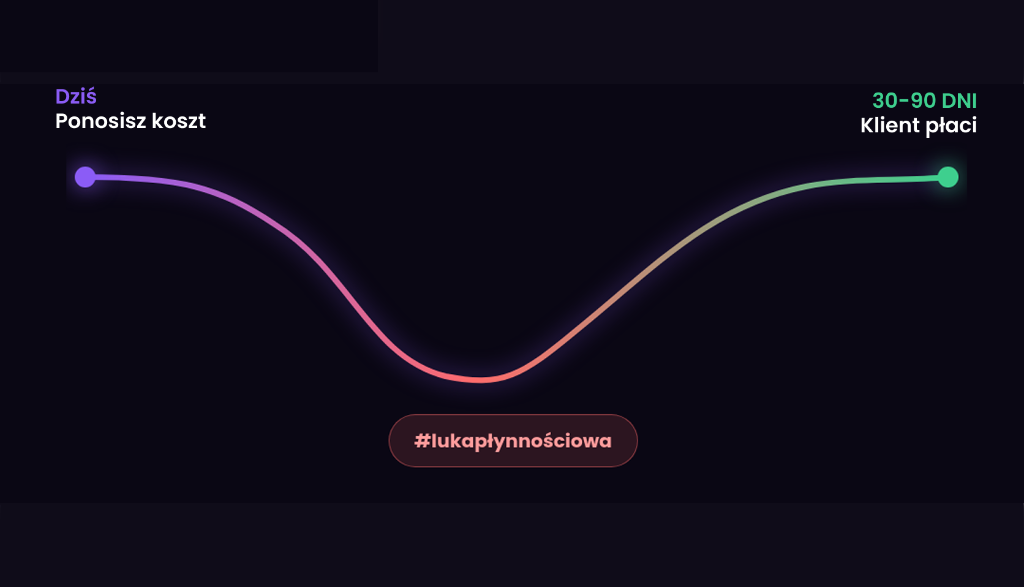
Service companies often start work before they receive full payment.
They have to cover up front:
- team salaries
- subcontractor invoices
- licences and software
- project delivery costs
- taxes and contributions
The client, meanwhile, may receive an invoice with a payment term of 14, 30 or 60 days. If they also pay late, the company finances their business from its own funds for much longer than it planned.
The problem is especially visible in agencies, software houses, consulting firms, design studios and other businesses where the main cost is specialists’ time. Salaries have to be paid regularly, whether or not the client has paid the invoice.
Profit does not mean the company has cash
A company can report a profit, have signed contracts and issue invoices, and still lack the funds for day-to-day payments.
Revenue appears in the documents, but the cash has not yet reached the account. In the meantime, employees, subcontractors, taxes and suppliers all have to be paid.
That is why payment gridlock hits cash flow first and foremost. Biznes.gov.pl, the Polish government portal for business, points out that companies affected by gridlock lose the ability to invest in growth.
How can you recognise a growing gridlock?
The first signal is not always one very large overdue amount. More often the problem builds up gradually.
Watch for situations in which:
- the number of overdue invoices is growing
- clients pay later and later
- the company sends many manual payment reminders
- new work is delivered despite earlier overdue amounts
- one incoming payment is needed to cover several payables
- salary and cost deadlines fall earlier than the planned inflows
If the company reacts only when the account starts to run short of funds, its room to act is already limited.
How can you reduce the risk of payment gridlock?
The foundation is ongoing control of receivables, not checking them only at the end of the month.
The company should:
- monitor invoices before and after the due date
- send payment reminders quickly
- analyse clients’ payment history
- agree advance payments and milestone payments
- limit long payment terms for risky business partners
- not start further work without checking earlier receivables
- factor probable delays into the cash flow forecast
Business owners may also be entitled to interest for late payment and compensation for the costs of recovering receivables, provided the conditions for commercial transactions are met.
How does Administy help prevent payment gridlock?
Administy automates the monitoring and recovery of receivables.
The system can:
- send a neutral payment reminder before the due date
- start communication immediately after a delay
- launch further stages of soft collections
- escalate the case according to an agreed scenario
- analyse the business partner’s payment history
- flag clients with growing risk
- factor probable inflow dates into the cash flow forecast
- stop further payment reminders once a payment is matched
Thanks to counterparty scoring, the company can see who can safely be offered a deferred payment term, and who calls for an advance payment, a shorter term or milestone payments.
Administy also shows how much money the company can actually expect in the coming weeks. This makes it possible to spot a cash gap before the funds for salaries, taxes or subcontractors run out.
Summary
Payment gridlock is not just an accounting problem. It is a real threat to the day-to-day operation and growth of a company.
In B2B service companies the risk is especially high, because delivery costs have to be paid earlier, and the client’s payment often arrives only after the service is done.
Administy helps monitor receivables, automate payment reminders, assess client risk and forecast actual inflows. This lets the company react to delays before a single unpaid invoice turns into a serious liquidity problem.